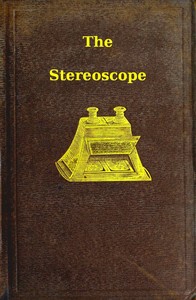
The stereoscope : $b its history, theory, and construction, with its application to the fine and useful arts and to education
Summary
"The Stereoscope: Its History, Theory, and Construction" by Sir David Brewster is a scientific publication written in the mid-19th century. The book explores the development, principles, and applications of the stereoscope, an optical instrument used for creating the illusion of depth in two-dimensional images. It discusses the mechanics of binocular and monocular vision, how the human eye perceives distance, and the historical context behind the invention of the stereoscope. The opening of the publication provides an introduction to the concept of the stereoscope, detailing how it works by combining two images—one for each eye—to generate a perception of three-dimensionality. Brewster explains that the stereoscope enhances our understanding of depth by mimicking the natural process of binocular vision, where each eye sees a slightly different view of an object. He elaborates on the historical significance of various figures in optics, like Euclid and Galen, laying the groundwork for the modern understanding of vision before delving into the specifics of how the stereoscope elegantly employs these principles to produce compelling visual effects. (This is an automatically generated summary.)